

Author: Keneth Twesigye

  • DELIVERING VALUE TO EACH AND EVERY CUSTOMER!

    DELIVERING VALUE TO EACH AND EVERY CUSTOMER!

    Tough times don’t last but tough people do, two years ago, the headlines along all global news networks was the rocket speed spreading pandemic that saw many industries close down, the fear in the air was evidenced by the empty streets, hallows, corridors market places, empty offices that were once crowded, a time to rethink and recreate our destinies, innovation and invention came to be the new normal.

    In a time like this, access to basic needs of humanity like food and water became the benchmark amidst a series of lockdowns, many companies globally, were thrown to the challenge. The food and agribusiness sector were one of the industries that kept operating throughout these tough times.

    Sumz food industries and Famunera, are some of the outstanding and known innovative companies to the business and entrepreneur community, and today stands tall and confident while many others in the sector are looking for their exits.    

    Without compromising value, quality, and reliability, Sumz food industries, and Famunera, among very many other companies in the food industry and farm inputs companies respectively are  deliberately and consistently delivering to the customer expectations.

    Curiously, everyone would love to learn how these two Agricultural value chain Businesses particularly in the agricultural sector have been able to withstand the ravaging tides of pandemic, the repetitive lockdowns, business uncertainties and unpredictable market situations, that our  economy is sailing against up to date.

    OBJECTIVES

    • To share key insights adopted from the new normal food service experience
    • To challenge food service practitioners to identify new models for customer oriented service delivery
    • To re-emphasize the effect/impact of branding in business enterprises.

    If you shall be attending the first day panel session hosted by TechBuzz Hub themed: DELIVERING VALUE TO EVERY CUSTOMER Register on http://bit.ly/KIW-delivering-value And for other themes and events of of the whole week hosted by different hubs, development partners and partners you can explore them here www.kiw.ug

    This year’s Kampala Innovation Week (KIW) shall be happening on a platform called Hubilo but when you register here http://bit.ly/KIW-delivering-value you will also receive a demo of how it works.

  • BOARD OF DIRECTORS VS BUSINESS SUSTAINABILITY – TRAINING

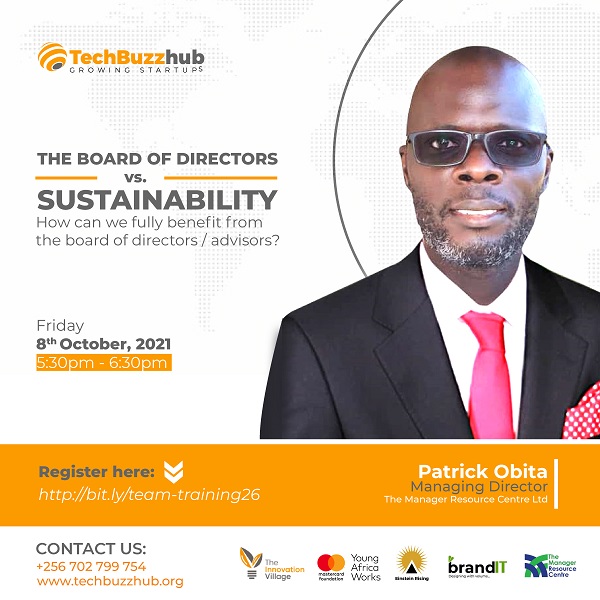
    BOARD OF DIRECTORS VS BUSINESS SUSTAINABILITY – TRAINING

    How can we fully benefit from hiring a board of directors/advisors?

    This training is a continuation from the previous training that was about hiring a board of directors. We want to have you understand what and how you can fully benefit from the board of directors that you hired. Carried on by non-other than MR. OBITA PATRICK, a managing director at the HUMAN RESOURCE CENTER, who happened to be the lead trainer at the previous training. This time round, he is focusing on the use of the board of directors and how to get value out of the board of directors and their membership. The only way a company can grow to the next level is by managing well their board of directors and advisors. Am going to be looking at some of here below.

    PILLARS OF GOVERNANCE.

    As a matter of fact, we must understand the pillars of governance at the very basic, because, the board of directors are at that level. In order to have good management, these pillars must be put in place.

    1. Accountability: You must be in position to figure out whether there are the different mechanisms in place to get accountability from the board or any other person in the management. Who is this member of the board accountable to, to whom so they report among others? Usually the shareholders of the company need to know the activities and success of the business/ company. In this case the board of directors must report to the shareholders and the owners of the company.
    2. Efficiency and effectiveness.  What structures are there that bring in the desired efficiency and effectiveness of the management and the board of directors. The system should be clear enough for the structures. In other words, as far as the board of directors is concerned is there a mechanism that allows them to show their contribution and value to the company and business.
    3. Probity and integrity. Are they thinking or do the board think about the integrity of the company and business? Do the people you have brought on board have integrity, are they people of integrity, or they actually don’t care about that in their business dealings. What kind of message are they sending to the stake holders of the company and business in as far as integrity is concerned?
    4. Responsibility. Do the board of directors know their roles on the company structures? Do they know and understand fully their responsibilities and do they execute them? Are there clear segments of their powers and what they ought to do or not do clear to all the members of the board?  Sometimes you find a board member seeking to involve himself in managerial duties and activities to the extent of asking for an office to sit in. what do they be micro managing? So it all goes down to whether or not they know their roles and responsibilities.
    5. Transparency. are they transparent in their duties and roles or they are the kind that wants to look for shady dealings within the company.

    Factors you need to be looking out for in your relationship with the board of directors if you are to achieve sustainability of your business.

    • Is the board of directors acting or exercising its duties in the best interests of the company, through exercising focused intelligence with discipline, loyalty and integrity?
    • Do the board members elected or selected meet the eligibility criteria? Or they simply made their way up to the board through relatives and connections with the company owners. With eligibility look out for their qualifications, experience levels among others. Do they meet or they don’t?
    • Adherence to the constitution and governance procedures, if the members of the board don’t do adhere to the company constitution and governance policies then your company is about to collapse.
    • Having an inclusive approach to governance, especially one that recognizes and protects that rights of the members and stakeholders. Do the members of the board feel like their rights are protected, they are part of the whole company? If they don’t then you may not get the best out of them. they will always take your company as a side hustle.
    • Do members of the board commit to ethical, professional, and lawful conduct. They must commit to be ethical and professional in their duties and services in the company. For example, its unethical to recruit one’s own family members as board or even staff of the company, a board member should not involve in recruitment procedure in the first place because its unethical.
    • Avoid conflict of interest in relation to their fiduciary responsibilities. Members of the board should never put themselves in a compromising situation that could then lead to conflicts of interest.

    Where you can avoid these then you and your company is of the right path.

    SINS OF THE BOARD OF DIRECTORS.

    A sin is any action, or in actions that goes against the standard board principles, ethics and laws which cause undesirable impact on the company in its goals of achieving the company goal. Just like sin in the bible, there are sins of the board of director’s somethings they ought and ought not to do.

    1. BOARD MEMBERS ARE RECRUITED BY THE CEO.
    2. Usually the person that recruits, gets to have the recruited pay allegiance to him/her and represent their interests. And yet the board members are to represent the interests of the owners or shareholders of the company or organization. Unless the CEO occupies two positons that is the board member as the founder and the CEO of the company.

    HOW TO OVER COME THIS

    • Ensure that recruitment procedures are well defined and the CEO is well defined in it, in as far as his roles and duty is.
    • Board members should never promise to be loyal to the CEO, unless he is among the owners of the company.
    • CEOS must desist from getting overly involved in the recruitment of the members of the board of directors for the one reason that as a CEO, you need someone who shall ask you the tough questions with an aim of pushing your business or company to the next level. For the sole reason of checks and balances in the company management.
    •  LACK OF DIVERSITY, and this is represented in the following ways.
    • There is a prevalence of gender issues and representations
    • Demographical changes such as age of the board members and the advantages of different age in the company discussions. You don’t want to have only old men and women on your board or only young men, youths.
    • Most board are full of old people of about 60 -70years, the problem with them is that they have low willingness to take risks, they are the kind who are there to get their money and pass time.
    • Watch out for having people on your board with similar backgrounds and experience in the sector. At the end of the day they wouldn’t give you much value as there is no aspect of diversity.

    How to overcome this.

    • While hiring consider difference in the experience and sector skill set, especially those needed for the diverse business operations. And define it from the word go.
    • Look at the creativity of the members. With different people comes different perspectives and this shall indeed help in making the best decisions.
    • Consider the background of the members of the board. Its important to know how and where his or her history was written from, his or her reputation and academic qualifications and skill set.
    • Consider the age demographics. Do not insist on having only the old people on your board but mix them up. Have a number of old and mature guys on the board as well as the youth. as a general figure some people prefer between 40 -60 years on board membership. Remember the younger the board the more curious and creative they become. You will want a board that is so curious about the changing and dynamic business environment.
    •  A WEAK BOARD CHAIRPERSON. It is awfully bad to have a weak board chairperson. He is the start of your business collapse. How do you get to know you have a weak board chair person?
    • He/she doesn’t mentor the CEO/ED, does not support the CEO/ED, 
    • Entertains rumors and gets information from other staff as opposed from the CEO/ED
    • Doesn’t take charge of board meetings to be productive.
    • Doesn’t work with the CEO or other board members in the process of effective board functions.

    How to overcome this.

    • Set ground rules that are to be followed by the members of the company.
    • Work with others to set the board agenda and also on the quality of information shared.
    • He is definitely responsible for ensuring all board members become exceptional in their roles.
    • You should therefore avoid being in the spot light every time. And let the management do their job. For example, involving in training capacity building. (that is the role of management)
    • OVERCONFIDENCE IN MANAGEMENT. Have you been in a situation where you are trying to give detailed information to a boss or even a director and all they want to here is where do I sign? and they be like “yeah, you guys can handle that, you guys are good at this I know etc.” as a board member or CEO you must keep track of everything to the detail. You don’t let go of your guard.
    • Such people do not scrutinize the work of management, so they end up accepting reports are they are presented to them without digging deeper into the facts. In that case the management can paint a god picture of the organization and yet in actual sense it’s a lie.
    • Loss of the sense of independent judgement.
    • Some receive information on the day of the meeting. Truly you cannot expect a lot of output from such a person.

    How to overcome.

    • Make sure and monitor the conversations between the board members and the senior management team.
    • Have the courage to ask tough questions and make appropriate inquiries as deemed necessary.
    • Make timely objective evaluations of the members of the senior management team. In this very line try to obtain informal unbiased information from third party evaluations and opinions as well.
    • Seek a deeper relationship with members of the senior management team to beyond the board room.
    •  Don’t take every single fact told to you as the golden truth, nothing else but the truth, for everything you are told is not true, try to further the validation of the facts.
    • A MEMBER ON TOO MANY BOARDS. As startups we must look out for figures that have a good reputation to join our board of directors, however, some of them are involved and are members of too many boards, this may limit their efficiency.
    • They stand at risk of conflict of interest and thus compromise the decision making process.
    • They will miss meetings and participate less in meetings they have attended. Most of the times they have something more important at stake.
    • They are therefore never able to read all the emails and paper work that is sent t them in preparations for a meeting. This in a way affects diversity, growth and mentorship by the member and to one another and to the CEO.
    • Their interest may be quite un aligned to those of the company i.e., material gains from these boards.

    How to overcome this.

    • Set a criterion to have the board of directors, and make it clear that they should not have or be in more than three (3) other boards at recruitment. Besides that, always keep track of their involvement with other board.
    • Set up proper rules of engagement of the members of the board of director’s activities and their implementation is crucial.
    • Members need to set the criteria especially the number of boards to be members on in order to avoid damaging their reputation.
    • CONFLICT OF INTEREST. Conflict of interest makes the board/ board member toothless, so much so that they cannot manage and make decisions on their own. How do you know there is a conflict in interest in your members of the board?
    • They will withhold information especially when they are the source or receiver of the information.
    • They will tend to manipulate the members on the committee
    • They may have unhealthy relations with staff of the company, which relations are undeclared.
    • They are usually involved in dubious dealings for example have the company recruit their relatives and friends among others.

    How to overcome.

    • Avoid situations that exposes you (board) to the executive influence to maintain your independence.
    • As the CEO, Strengthen the board committees where board issues are discussed and sorted from which recommendations are then absorbed fully.
    • Coopt other relevant independent experts on the relevant committees of the board. These will often do their job objectively advising you and providing you with the facts.
    • Have an advisory board or a shadow board to discuss the company issues. They advise and it’s the board t either take up their advice or not when it comes to decision making.

    If you can overcome all these we have talked about above, then your company and business is in the right direction.

    Question when is the right time to institute the board of directors?

    We mentioned in the previous session that for startups its better at the moment to have board of advisors, relate with them and build rapport. It’s very important.

    Question. Is there a limit to the number of board of directors?

    Well to a company it’s good to have a small number of board of directors. The reason lies in the ability to make decisions faster. The fewer the board members the easier and faster the decision making. The larger the number the more the lengthy the process becomes. At least have a number that goes between 6-7 board members.

    Question how does one legally come up with a board of directors?

    It’s a statutory requirement for every business that is opening or starting to have a board of directors, however, sometimes you do it early because you want to be in a better position to have funding from donors.

    Question what measures can you take up if they are the major funders in the company?

    If am the CEO and founder of the company, I would like to let some of the responsibilities off my shoulder in order to have the company move forward. In other words, for the betterment of the company then you have to choose whether to be this or the other but not both.

    Does sole proprietorship also require a board of directors?  still related to startups I would advise that having a board of advisors is good enough for sole proprietorship. How long should you change the board? It can be at least 3 years. Some people have their term up to 6 years. But the whole idea is to have new faces and experience in the company.

  • FINDING THE BOARD OF DIRECTORS – TRAINING

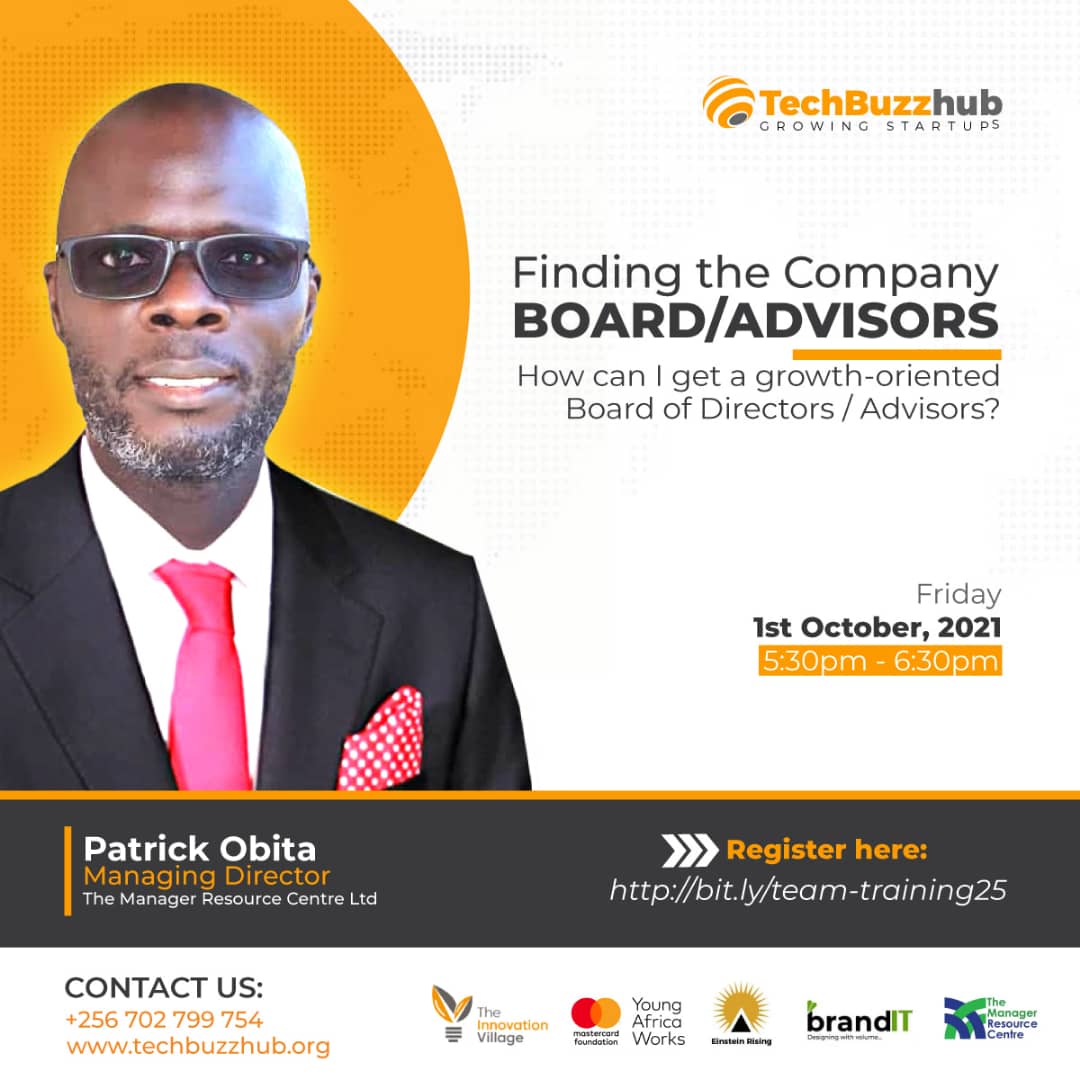
    FINDING THE BOARD OF DIRECTORS – TRAINING

    How can I get a growth oriented Board of Directors/advisors?

    This article today is brought to you by TechBuzz Hub in association with its partners the mastercard foundation and the innovation village among others. In a special way today, we bring you Mr. Patrick Obita.  A management consultant, author, family man, artist, founder of kiti children sports, co-founder, manager resource center. With vast experience he shall lead us through what he does most, coaching and training managers in various managerial aspects.

    The metaphor of a tree.

    All of us work in beautiful companies. The tree represents companies we have, it’s surrounded with a lot of things it has to manipulate to keep standing out. Right now a lot of companies are facing uncertainties that have disrupted the business environment.

    The tree can’t stand tall if you don’t have good behaviors that are constantly changing. Under the tree being clean so its kept close, might be a golf course, surrounding cleared so tree keeps standing tall above each and everything around it yet environment keeps changing.

    Companies facing a lot of issues of codes of conduct and basic practices which are being recommended at the investor level, global level, regulator, national, corporate governing industry and academic study field, all these need a director to provide professional guidance/ need to understand conflicting signals coming from these many sources.

    At the end of the day for the company to stand tall, need to stare through all these challenging times, how changes in the interest of stakeholders, disruptive business environment by having a board of governors.

    What is the board of directors or advisors?

    It’s a group of people who jointly supervise activities/operations of for-profit or non-profit. Their work is basically to supervise and give guidance on the different operations that go in the business.

    Starting the selection, starting the selection may really involve a lot but not really too much as shall be mentioned below. However, there are key questions that can guide you through. It involves legal requirements about the constitution, founding members, what type of board do we need, supervisory, single tied, why do you need them? To grow business, improve governance, legal requirement, 

    what’s pushing you to have them, what’s pushing me if am founder, are you ready to relinquish power and authority, to these people or not?

    major purpose, accomplish formal object set out in company foundation documents, might be written or not, short term or long term, 

    How we achieve that?

    We can achieve that using powers vested in them, guided by foundational documentation, applying wisdom and experience to solve company problems, only achieve major purpose if apply collective responsibility principle, balance interest of staff, regulators, governors, investors, whether inside and outside

    How the boards come on?

    They are elected through and by shareholders, you have a SACCO and contributors are shareholders and elect committee that steers objectives and oversee running of it, administration wing of Sacco, strategic direction for it, advertise for them to come on, they are then recruited either by management, a committee of directors or trustees.  insurance advertise for a board of director positions if you have the quality, innovative, knowledgeable, appointed by founders/ trustee want to get out of the process of management and also need for fresh ideas.

    Advisory board

    This is a group of individuals selected to help advise the owner regarding issues such as marketing, financial, legal, management or it’s a body that advises the board of directors? They simply advice directors on issues they’re facing but have no voting power. other names for it are “thinktank”, steering committee, project board, business advisory panel, advisory committee/team/ group

    CHARACTERISTICS of advisory board

    • They are a volunteer group; this means that they are not paid for the work they do in form of a salary.
    • No formal legal responsibility, 
    • No decision making authority, they do not have the power to involve in decision making of the company. 
    • Don’t issue directives to be followed, subsequently they do not issue directives with an imperative to be followed
    • Formed by management or board, the board of advisors is formed by the management or board of directors to help them in making the right and informed decisions on the company. 
    • Report to management or board, the board of advisors always reports to the management/ CEO or to the board of directors.
    • Rarely compensated- work for free in exchange for networks, growing profile since they are even voluntary

    PURPOSE OF THE BOARD OF ADVISORS

    • Help company gain new insight to solve problems/ out of box thinking. This is because they advise from a non-biased point of view 
    • Help explore new opportunities/stimulate robust quality conversation,
    • Provide current knowledge, critical thinking, analysis- making the decision maker confident
    • Guide quality improvement, question process, manage the operation, 
    • Encourage exploration of new business ideas
    • Challenge how work is done in the company

    WHEN TO FORM ONE

    Then the question when do you need a board of advisors. Simple, when there’s a major crisis, current issue or a new concept. When you need to address the issue outside the usual scope of the formal board, need to expand the company.

    Dos’ when getting board of advisers (what are the things to do when getting the board)

    Interpersonal chemistry with prospective board members, create an interpersonal relationship with the particular people you want to bring on board. Let there be rapport between the two of you because these are the people you are going to be trusting in a few months or years. 

    Show them the passion for the company focus area, and let them vividly see or experience it, thus they shall have the capability to help, avail time and willing to be advisor, get those willing to lend their name and credibility but not giving actual work to it. 

    Don’ts OF THE BOARD OF ADVISORS

    They are not expected to be doing the following so much so that when such characters are sighted, should be a trigger that they are not the right people for the job. 

    • Short sited people, 
    • Reactive, 
    • Narrow thinker/no challenge, 
    • Pessimistic persons/negative/ underappreciating work done,
    • Lack of diversity/gender-issues/experience wise/only same thinkers, qualities don’t complement the board, 
    • A person with a name but no knowledge skills or expertise is not a good fit for the board of advisors.

    Considerations when forming an Advisory Board.

    When forming a board of advisors, you may want to have a few considerations in place as you form the board these include;

    • what`s expected from them, it must be clear to both you and the individuals or the group of individuals what you expect of them as well as what they should expect of you. This can be in terms of the mandate, goal/focus, compensation, 
    • terms of membership on board, the terms of the membership must as well be clear to all the concerned parties, this includes the size composition, frequency of meetings, confidentiality, ownership of ideas among others.

    where to find members 

    For those who have never done this could be asking themselves where can we find the particular people we want on our board of advisors. 

    • Your connections, your social network, people you have and are interacting with can be a good source. Why? Because you already know these people and you therefore have already built rapport with them. 
    • Former professors, family members, friends, that whom I rhyme with, networking/ get to know people, expand your scope of friends, attend community meetings, stop keeping in your cocoon
    • Ask from peers or network, you can as well ask the people you work with, your friends to help you find more other people that can be best fits for the 
    • Meet with potential advisors to see if they fit/ try and fail but never fail to try

    Q: Which suits a company best? board of directors/advisors. throw more light on, and different the role of board and management

    Ans: Board strategic and governance body that oversees the direction the company is supposed to take and set the direction, management is concerned with day to day running’s of the company e.g. staff recruitment.

    Q:  How can you gently fire a board member?

    Ans: For an advisory board, it is easy to fire/let them go, it’s not legal, they’re just giving you advice, if board of directors, providing governance and they’re by legal documentation, can be sued if they don’t do what they’re supposed to do.

    Q: What is the board charter and what does it do in relation to the board of directors and advisors?

    Ans: The board charter should carter for all this, you can all decide whether to have an advisory board, whether there should be having them or not, the advisory board can be any number but the board can be specified in the documentation or legally

    Q: What is the relationship between shareholders and board of advisors? 

    Ans: Shareholders are owners of company and board are people that give their opinion about the company e.g. how’s it doing, how it can move to the next level, a shareholder can decide to get a board of advisors

    Q: Regarding an advisory board, if as a founder you need advice, do you contact one by one or meet all at once.

    Ans: Depend s on your need, you can have one on one depending on the expertise of the person or call all at once if you know they`ll give you the best advice all depend on how you’ve structured the.

    Q: Do you recommend a transition from advisory to the management board, at what point do you transition?

    Ans: Sometimes, boards of directors use advisory boards as a ground to train the board of directors, indirect grooming

    Q: Highlight the setup of a board for a non-profit entity

    Ans: The Board of directors depends, going back to the constitution of that entity, NGO and nonprofit stipulate the kind of people they need on their board. at that level that you have the different boards come on for a non-entity for example; assuming it`s a tertiary institution and regulation says you should have 13 and so many should be ripping the community, the ministry, all this depends on foundational documentation.

    Q: Does it matter the number of employees or size of capital to be able to work on having a board or advisors?

    Ans: Board of directors is an expensive venture, if the company doesn’t have the financial ability, they should then get a board of advisors where cost is deflated.

    Q: Highlight the setup of a board of directors/advisors of a non for profit org and how is it set and what practical framework can guide this setup

    Ans: Legal policies, documentation, legality, is what forms the board of directors.

    CONCLUION

    keep in mind, just advise, peoples opinion, the company is yours, it’s you that listens to the customers, whatever doesn’t rhyme with your gut, get another decision, you will have to synthesize whatever you’re feeling and make the decision.

    Thank YOU!!!!!!!!!!!

    The next webinar and blog brings your mind to finding out how you can sustain your company alongside having a well built and fully fledged board of directors or advisors. Make it a point not to miss out, and invite a friend or two.

  • MANAGING HUMAN RESOURCE – TRAINING

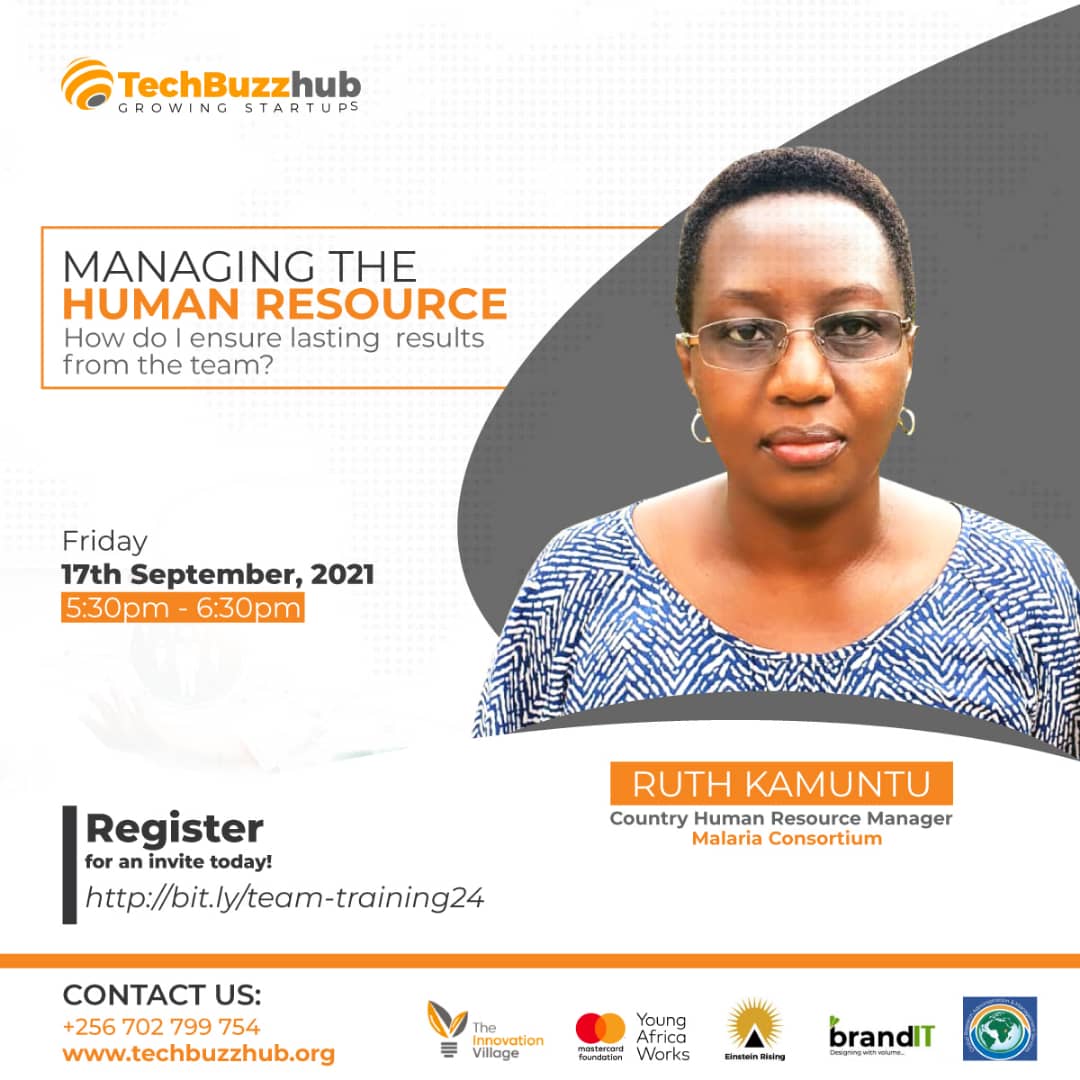
    MANAGING HUMAN RESOURCE – TRAINING

    How do I ensure lasting results from my team?

    Moving forward from the previous training that involved getting your team to work together to produce results, we arrive at managing human resources. In this case Ruth Kamuntu would like to speak to the hearts of the young ceos, the young directors, the newly appointed managers, and any business owner out there, who has got a team that he leads, calm down and let’s delve in what it takes to have you team cohesively working together to produce A+ results.

    WHAT ARE SOME OF THE TECHNIQUES THAT YOU NEED TO HAVE YOUR TEAM PRODUCING AT HIGHER RESULTS ?

    Techniques/ methods that will help you to manage and maintain an A TEAM

    Building and maintaining a great team, includes you.

    • Look in the mirror

    The energy of the company begins with you as the director. If you are not excited and inspired, your employees won’t be either. As a leader, your mind set is your most important asset so you have to continually work on it as part of your self-care routine. When you wake up in the morning then you look at yourself in the mirror if the kind of person you see is not the kind of attitude you want to meet at your workplace then change it there and then. Be the kind of person you want to have at your company.

    • Be a cheerleader not a coach

    Great leaders bring out greatness in their team because they see what is possible and transfer that belief. So as a business owner, it is your responsibility to bring out that greatness in your team. Motivate them and cheer them up and bring out their confidence instead of lecturing them. In other words, be the person to move closely with your employees rather than stand at a distance to see them walk. A cheerleader doesn’t care what mistake you have done or how many turnovers and the fact that you are 10points down in the last minute of the basketball game, on the contrary focus on the target, the ability to achieve the target and the capability of success, because they have seen you win once and they believe you can. A coach on the other hand sits on the sidelines to back orders and new strategies to win the game. Many times your employees need motivation as compared to strict supervision.

    • Practice empathy

    The old school management technique of using negative reinforcement to drive results has been proven ineffective and it also creates an unhealthy work environment. The moment you start using these negative talks to your team, they will stop opening up to you. A great leader should be empathetic. He/she should feel for their employees to build a strong relationship with them which will boost their morale and ease working together as a team. empathy increases your rapport with your employees,

    • Pile on the positive feedback.

    Overwhelm them with positive feedback on the big things, little things any chance you get. Most managers only give feedback when it’s negative or corrective. For instance when they make great sales, pat them on the shoulder and thank them. Show that you recognise their efforts. One of the most important things that people want is to be appreciated. To know that their efforts are being recognised and they  matter to the company and the organization. It helps kick in the motivation to even go beyond the boundaries, beyond the limit just to get the job done.

    • Get out of the way

    Give them space to pull out their skills, in your presence, they might feel timid sometimes. It’s not that you go away for good, just give them their moments once in a while. Backing away is one way to motivate your team. Demand results and excellence while giving them their moments to perform their tasks alone. Do not micromanage your employees. If you trust them then give them their peace. Top performers need space to do their best. Do Not go away forever but rather give them space and once in a while get back to them in a result oriented space.

    • Remember your manners

    Saying “please” and “thank you” go a long way. Saying thank you is a specific and tangible way of letting your staff know that you know how much effort was put in. Greet them and appreciate them, practice simple manners to make them feel valued and that gives them motivation to perform to the best of their ability. Working with a boss who does contrary makes the subordinates feel like they are slaves and not part of the company and so they just perform to the bare minimum. They will never go across and over.

    • Keep your doors open

    Proactively demonstrate your eagerness to support your team by maintaining a regular schedule of one on one time. Think about everyone and hear them out regardless of what level they are working on. Avoid being that boss that has a closed door and you only get to the office when something bad is going to happen. Always be open and accommodative to your subordinates trying to get them to know what to be focussed on. Let them know the limits and be very keen, listen in and reflect before you give the feedback.

    • Make them part of your mission

    Make sure your leadership is aligned with the vision of the organisation and that this vision is featured prominently and enthusiastically in all your leadership communications. Remind them of why you started the company and what you want to achieve. Let them understand that their everyday contribution will lead to the success of your vision and let them be part of your journey.

    Other key points to note;

    • Develop purpose, vision and values- does your business have a vision and purpose and mission. Do your employees know and understand what they are supposed to do. Their expectations
    • Connect with everyone on your team – being there to plan and review with your team. As a business owner you must be able to get feedback on your business. You can only get this through feedback and various (standup) meetings in the team.
    • Build trust among team members – promote autonomy in your team and among your team members. Let them feel able to make decisions on behalf of the company and organisations.
    • Show concern for team- it’s all about listening to your team, both at the individual level and at the team level. Empathy goes a mile. Be sure not to over do it. Know the limits and let the limits be clear to both the employee and the team.
    • Track how they spend their free time- it is also a good practise to know what they want and how they spend their free time. It contributes a lot to their overall efficiency and effectiveness at the company.

    NB. IN THE CASES OF FEEDBACK HOW DO YOU HANDLE CRITICISM AND NEGATIVE FEEDBACK ESPECIALLY PERSONALLY?. It’s good to be emotionally mature and have an emotional quotient is part of your responsibility.   Sometimes when you fight back they close the door for feedback. I appreciate your contribution however for the sake of the business we are involved in, and the kind of competitors, then we have to do it this way or that way in order to stay in business.

    • The issue of listening. It goes back to the issue of making the boundaries clear. Getting too emotionally attached to the employee is not something you would want to get into. It can easily impair your decision making. Much as you must listen closely to your employee, keep in mind the boundaries and limits of the employee/ employer relationship.

    Quote to live by; “talent wins games, but teamwork and intelligence win championships” Michael Jordan

     “Coming together is a beginning, staying together is a process, and working together is success”- Henry Ford. Proudly brought to you by tech buzz hub, adapted from the webinar on which we had Miss Ruth Kamuntu was the main panelist. If you missed the webinar, make sure you don’t walk away the same way you got to this website.

  • TEAM BUILDING – TRAINING

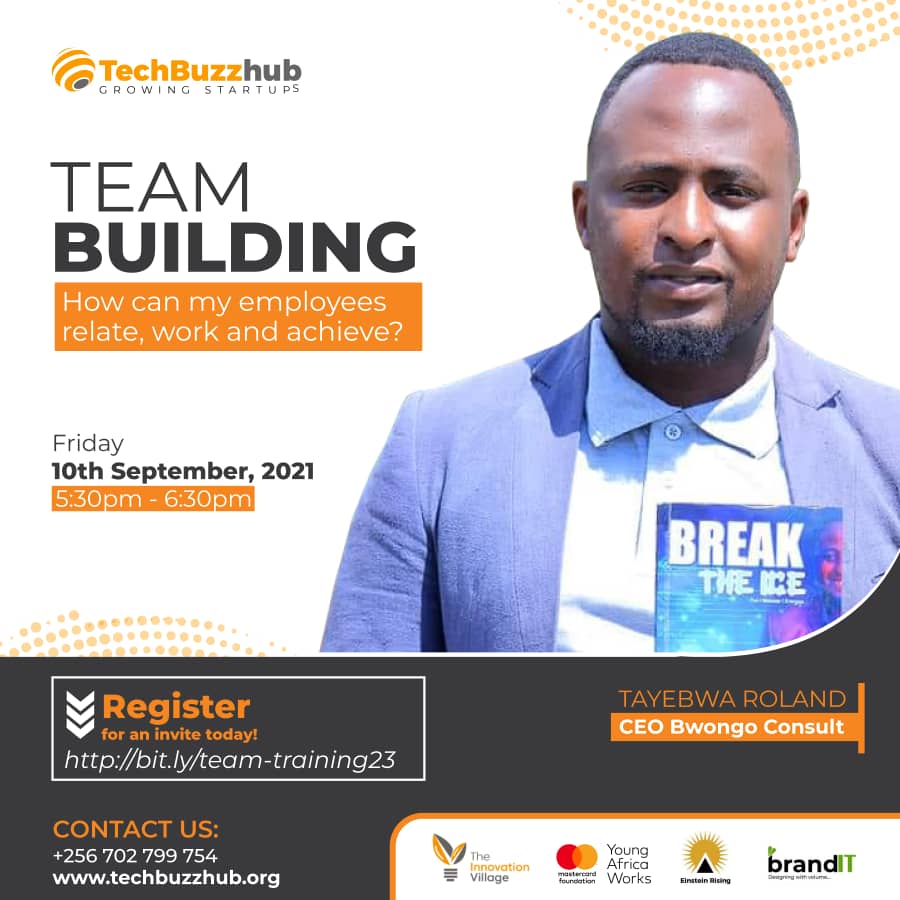
    TEAM BUILDING – TRAINING

    How can my employees relate work and achieve?

    The ARTICLE is brought to you by the team from TechBuzz hub after the very webinar about the same that had Mr. Roland Tayebwa, a proud father, consultant trainer and CEO, DIRECTOR and FOUNDER at Bwongo consult, present on the live webinar and these are part of the what transpired in the meeting. And for those who did not have the chance to attend the live meeting, patiently go through this article to get you sorted on the various other things you need to know about team building.

    BY the end of the presentation we expect to now the characteristics of a wonderful team. The four stages of team development, individual differences and roles within a team, how to relate and work together in a team.  Before going further to understand all the afore mentioned subjects we need to understand what a team is

    What is a team?

     A team is defined as a group of people who perform complementary interdependent tasks that have a high level of interdependence to work together to accomplish a common mission or specific objective. So they share different capacities and abilities. The reason why we set uo teams is because we want people do thing that I cannot do on my own.

    What are the characteristic of effective teams?

    There are very many kinds of teams such as the dormant teams, successful teams, lazy team, effective teams among others but today I shall focus on the effective teams.

    • They must have a clear vision or purpose. A vision is a clear and concise statement of purpose Something that brings you together, it appeals to people’s imaginations and motivations, in order to achieve a set milestone or target. Everyone as they are coming to the team then they must be in line with the vision. It’s a fuel that pushes you to another level.
    • You must have a shared commitment. If each member is committed to work towards achieving the vision each one works towards their own reward because of your commitment to work towards the vision of the team. If you are not committed to what they are doing then you are not an effective team
    • You must have clear roles and responsibilities on the team. And each member should know what the other members are doing in order to look out for the interdependence it makes everyone know what they bring to the table and how much another person offers to hit the targeted goal. After knowing your roles and responsibilities then you must have trust.
    • You must build Avery strong wall of trust. With a high level of trust members are able to go beyond boundaries, through ups and downs, in order to get the job done. You can only be sure that your colleague will deliver only when you trust him and you are sure he can do it.
    • We must develop mutual accountability and support. Team mates should be able to be equally accountable to one another. Because that is how your team wins. The performance of the team improves with the availability of mutual support, getting to know who is this person am working with on the team what are his abilities and inabilities, and how can we achieve a goal thus allocated to us.
    • Celebrate individual; and team success. Before we are a team, we are individual. The general success of a team is only known and achieved by the individual winnings and achievements. Therefore, its only logical that celebrating individual successes a=before you celebrate team or general successes. It helps motivate every team member who has added a milestone to continue working harder.
    • There should be a serious concern for the mini tasks as much as the group tasks that must be done by the team. Success moves from the individual to the group, the small tasks management, the fact that the petty cash must be taken care of is very important as much as the biggest sum expenditures on the team.
    • Address challenges with creativity. Solve them in a more creative and innovative way. How do you address a challenge at work, because how you address these challenges is very key on how to have an effective team? Which information or concern is for the whole team to know and learn from and which one is to be handled in isolation. As a team leader you must judge.
    • Inclusive decision making is key. Team members become so effective and show a lot of performance when they feel involved in decision making process so the team, or organizations.
    • Regular communication and feedback is very important. You must keep regular and timely communications. How you communicate and give feedback matters. Because motivation is something that you as the team lead do not want to lose in your team or else it ends up being ineffective.
    • Close work friendships create employee satisfaction. How much do you know your employee, do you what his life after work looks like, because it affects how you are going to work and your performance will improve. It’s good for a team leader to create and make a lot of rapport with his team members. Remember we can be on the same team and yet we are friends, however we can be on the same team and yet we are not friends. Always note that limits are good enough to keep at the back of your mind while trying to create rapport with your team mates. Avoid sending the wrong information to your team mates especially of the opposite sex.

    Stages of team development.

    There are various stages of team growth and development, such as forming stage, the storming stage, norming stage, performing stage among others. These we shall look at in a little more depth.

    1. Forming stages. It involves the whole process of orientation and getting acquaintance. There is a lot of uncertainty, and people are looking for authority. Team members ask questions like, what is expected of me, will I fit in, most interactions are social and members get to know each other.
    2. Storming stage. This is the most difficult and hard stage to go through, it is a period marled by competition and conflict as individual personalities start to come out.  Team performance may actually decrease as people engage in less productive activities such as proving oneself to the boss. Many members are looking forward for recognition. Energy is being invested n un productive work. Members in such as stage of team development must work to overcome obstacles like individual differences and conflicting ideas on tasks and goals.
    3. Norming stage: if teams go through the storming stage, conflict is resolved and some degree of utility emerges. Consensus develops among the team on who does what and who is good at what exactly. However, the harmony is precarious, and if disagreements arise the team can slide back into the storming stage.
    4. Performing stage: in this stage the team is mature. It is well acquainted with the structures, vision, mission of the organization and usually smoothly functioning. This is to the extent that when conflicts arise they are easily managed by the team members and leaders.
    5. Adjourning stage: at this stage most of the processes of the team are achieved. and there is usually no much to add on. Everyone understands and knows each other’s tasks and duties, the structures are clear and the team follows through smoothly.

    Discussion questions. These are some of the questions that you must be in position to ask yourself in order to measure and see where your team is currently at, in terms of development levels.

              A) when did your team form?

              B) what are the circumstances in which your team grew, to what it is now?

              C) have you seen the three 3 stages of team development in your team.

              D) what needs to get you to the next level and stage?

    What advice would you give employees joining a team? Especially when face with a circumstance where they (new member) knows better and more efficient way of addressing a task, but the old team seems not to think it would work.

    Simple as it sounds, for an employee joining a team, you must be humble and try to blend in. behave like a chameleon that means first understand what they do and how they do it. Once oyu understand their perspective of though and doing things, then you can introduce your idea. Remember its always good to cultivate patience.

    How do you advise a team to get past the storming stage?

    For a team to first of all realize that they are in the storming stage is by the traits that we already discussed. Besides that, one must practice patience and endurance. It is in storming that I advise businesses to do organizational team building such as gatherings and outings.

    Usually there is no time frame for how long you might last in the storming stage. It can be short or definitely long.

    How do you deal with a colleague who is constantly dragging the team down, he is basically a disappointment to the team.?

    • Always encourage and remind him that we win together. And that he must understand that fsct.
    • Approach them, or someone on the team must approach them and let them know they are dragging the team by their character and that its not fair.
    • Make him know if there is a possibility of rea signing him as according to his strengths and not weaknesses. And lt them know about the possibility of having them a different role.
    • Losing them is and should be the last option after they have failed to work with the system provided to them and the structures of the organization. Let them try to fit in the structures that exist in the organization and have them improve. Firing such people should be until then.

    Finally remember, that as team lead, or the leader of your organization there shall always be somewhere where one of your team members is better than you are. Hence you are indeed important to the company or organization but not irreplaceable.

    A team is as strong as its weakest point, this means that you must always keep your team in check and focused. It’s easier to manage the team when you know clearly what stage of growth and development your team is at.

    Wishing you all the best as you build your teams for a better franchise and work force. Look out for our other webinar aeries and blog that are coming up.

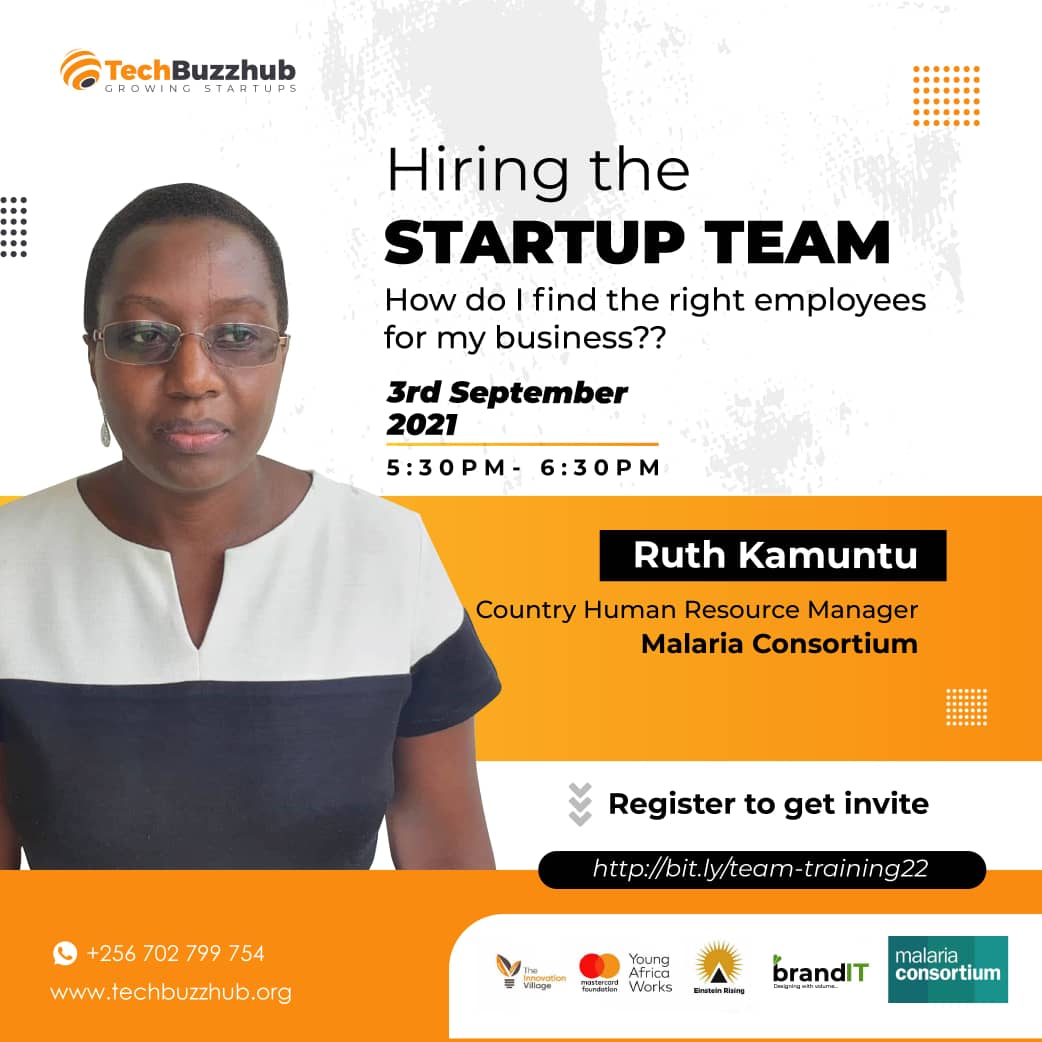
  • HIRING A STARTUP TEAM – TRAINING

    HIRING A STARTUP TEAM – TRAINING

    How to build a team that will not sink your startup?

    Presented by Ms. Ruth Kamuntu a senior human resource manager working with Gotham and the malaria consortium. She is so good that to rephrase her presentation would easily dilute her expertise. So with little to no option, its only right to have it in her words.  Let’s dive right into it.

    “Great things in business are never done by one person, but by a team”. –Steve jobs. “No matter how brilliant your mind or strategy is and you are playing a solo game you will always lose out to a team” – a cofounder of linkedin once noted. If your business is going to succeed you need a team. What does that mean.

    A sourcing strategy. What is your sourcing strategy, the screening itself? recruitment chain, recruitment as HR.  how successful is your recruitment? How do you want to do it? when is your need, who is your need. Enhancing the reputation. Is all about the team.

    A successful recruitment on the other hand is best aligned and when you have identified they are very active and they shall contribute positively in youth business. 

    What re the drivers to help you know you have a best team on board that will not sink your team?

    Self-awareness. Means you are the owner of the business. It is the foundation of everything that is good. If you know who you are, your personality, values beliefs. Then you can hire people that will help you grow and later get you challenged as well. 

    What is your vision. Your vision is among the things you must consider. share your vision, with your team, begin thinking of how best you can share your vision with the people you want to being on board, and how best do you think they can understand it. The vision will help you create a culture, the values and practices, let your vision be their vison. when they buy into it then it will be way easier for you to push the business forward. 

    A famous quotation, “a satisfied customer is the best business”, made by an American business man – mike. The reason as to why you are starting up is because of your customers. Select that team which in customer service oriented. Think about that person who is going to help you satisfy your customer. There will be no challenges in revenue if your customers as satisfied. 

    When starting up organizations. We consider hiring action takers, we literally want people who are ready to get the job done. You want they people that will take you forward. People who can go for it. They are ready to get the job done. When you have such people they will think first. Consider hiring people who are not merely idealists but those you go forward to see the idea through to reality. Don’t hire people for the sake of hiring them.

    Ring masters. These are people who coordinate the circus. Becoming an effective leader. Know he traits and the goals of your team. Get to know who is doing what at what time? Create that rapport that they people you are leading can do what they are supposed to do with or without your presence. Make sure they work together to create a Sameless show.

    Think long term. Bringing great people on your team is about demonstrating that size doesn’t really matter it’s the people that matter. Let me start with these two whether qualified or not, then I will get the others later. this is the greatest mistake. You are creating at the startup tem. Don’t build a team for a startup.  Build the team with an organizational structure on a big vision. So much so that think about the bigger picture and how things will be run at a time when it’s a bigger business organization. 

    Inclusion in diversity. Most of our organizations, we start them up solo or family, when it’s the family many of the family members get involved thus homogeneity. However, it’s good to involve a lot of diversity. Because we need a lot of creativity, and innovativeness. Do not fear to hire them basing on the fact that you don’t know them irrespective of the fact they are skilled and have the competencies. Do not feel in secure, because they are the go getters. They are the people who will help you to grow. 

    Startup team personalities.  As you hire your start up team please get to do thorough recruitment, and encourage effective communication. You must expect a lot of friction from the start but when they come together and they have bought on to the vision then they can be a great team. But with effective communication between you, and the team, you and the person you have, then also between the team members. 

    Recruitment and selection.

    • Consider investment in the recruitment officer or we can do it at the right pace in order to get the right person. The poster that you put out there does not guarantee you the right person to hire. A recruiter may be expensive and all startups will narrate how they don’t have money and they can’t afford a recruiter. In my opinion I would actually think it is better to invest in a person who has done this for a while and can get you a person that will actually fit in the team you are building. “the secret for successful hiring is this look for the people who want to change the world” mark 
    • Borrowing the sports field in this version. Every team member has a role, from which every member is accountable, there is always a training, they make analysis, and they never lose sight of the driving force which is the vision of the sports team. 
    • Translating it to the startup team, have roles that are clear and distinct from each other in how they are supposed to get the team running smoothly for the attainment of the vision. 
    • Train your team, the training should be continuous irrespective of competencies.  What competencies does he need?
    • The flexibility part. How flexible can he get to be on the job? The landscape of the business keeps on changing how best can the person you are bringing on board, be flexible as the business changes. 
    • Never lose sight of the vision of your business and find out their driving forces and use them to get the best out of them. Always listen to your team.

    Please note; that “the hire slow fire fast monstra” works; hire slow because you want to get the right person for the work. Fire fast because you don’t need to keep the person not doing the right thing continuously on your team. They will drag your startup down.

    • Do not settle for someone who isn’t right for your business.  
    • Focus on growth, do not spend a lot of money and time cleaning up messes. The right people on the first day will help you grow.
    • Cost of hire, put up a thorough evaluation process before you hire the right person. If it’s a sales person give them a practical. Why wait to pull the plug on the wrong hire when you clearly know it’s a wrong hire.  Don’t hire because someone told referred her to you.
    • Sometimes it’s about engagement. Train your team to do better, be there to see how she handles her sales and customers. Even if they are the right hires, they could be having a few things that they don’t have to fit in well in your business.
    • Sometimes something to do with motivation happens. Motivation levels will go down when you make the wrong hire to make a right hire. The right hire shall pull them down. Make sure that the team has those people who are the go getters. 

    How do you deal with competitors because they bad mouth you? From a human resource perspective, competition is very good because it keeps you on your tip toes. But always focus on the positive things that come along with it. Involve your team to find out where and how best you can improve your game as regards the competition.

    In conclusion the right people will take your business across the finish line, the wrong people will make your business go down.

    “This is one of the most practical training that I have ever attended and I would like to day that techbuzz hub should take up this training and bring many people in the know of it, because I believe it will help a lot of many young entrepreneurs.” Ricky Rapa Thomas – Founder safe boda 

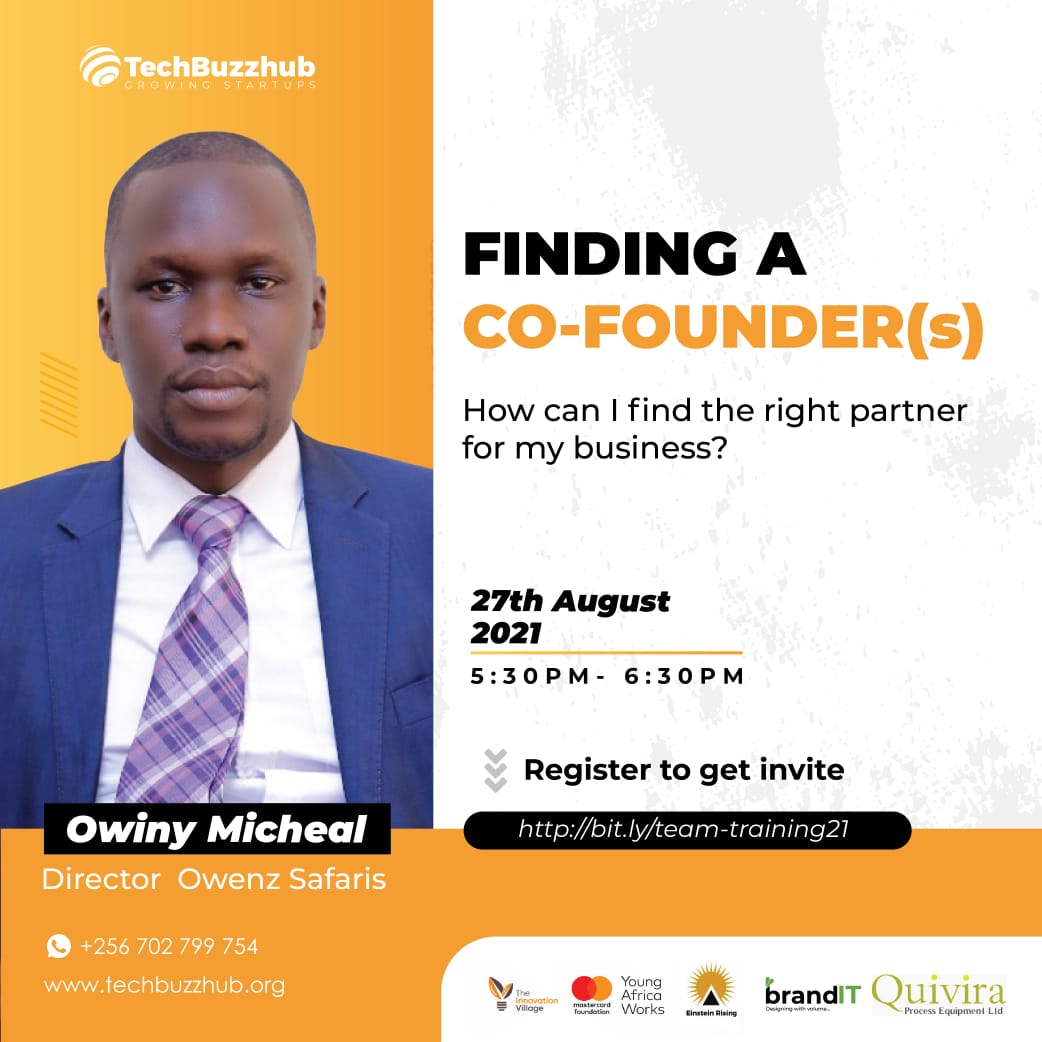
  • FINDING A CO-FOUNDER’S

    FINDING A CO-FOUNDER’S

    How can I find the right partner for my business?

    We start a new series of webinars with a new theme “team training” that is actually going to move forward from ideas, now we expect you to have a business and seen it start, however we believe you need someone to move your business forward with. From our very first webinar by KENETH our team lead, we move on to this very theme in exploring the fact of how do you find a new business partner, taking us through this is MR. OWNIY MICHEAL, an advocate with KAGANZI AND COMPANY ADVOCATES, DIRECTOR AND FOUNDER AT OWEN SAFARIS LTD, …… brings on board his experience, right from primary school level.  What? Why? and when you need a co -founder, with an intention to open up your mind.

    “My first business started in primary level at around 9, I was selling mangoes. In the very many other businesses that I have been a part of some of which I hunted for co-founder where as others people hunted for me” he says.

    Who is a co-founder? 

    Somebody you start a business with. A lot of people in Uganda have a problem starting a business with another, due to ever ego, or prior experiences. For example, Xiamen company CEO who went out in searching for specific people he needed in his business. A kind of people who would individually qualify for a CEO position on their own. When he got them up together, his business registered a tremendous growth in a few years of start. Another example is Steve Jobs and his other partner prognier for apple. I will still refer to the greatest start up that has ever existed, a family. It usually takes a while to find someone to get married to

    Why would you want a partner?

    From experience we had a really hard time in the beginning, we had to wear very many hearts that included working for about 12hrs a day, among very many other responsibilities. Some people will tell you they don’t need a business when they have just started.  May be right or wrong. 

    You need to distribute stress. You find someone who can take some part of the work load off your shoulders. It really means a lot. You either find someone you bare the stress alone. 

    To avoid business zombie. When you are alone you may find your business remaining stagnant at one level and at the 10th year, you still are earning as you were at the 2nd year. Many of these fail. If you work with another person in times of losses, a partner can always push you to newer ideas of how best the business can be pushed ahead. 

    Mitigating risks. It becomes easier to mitigate risks when you are two people running the company yet when you were alone it rather hard as the saying goes, two heads are better than one.  You will be more trusted if you have people with more experience and expertise. Therefore, you can always find a way out of the corner your business is pushed to. Someone will be more willing to work with you if you have many or a few people who have worked in the business given the fact that you are a startup in the business. This is majorly because of the directors a managers and co-founders in other businesses.

    How do I identify a co-founder?

    A lot of people give them very names, I want to look at the characteristics of the individual from the a business perspective. Am sure you can recognize many of these around you.

    Dreamer. the dreamer is the person who is always thinking about new things they want to think outside the box. He is always thinking about crazy things. They are usually terrible under stress. A sandwich, what if we try peanut butter and jelly, you know it would make a good sandwich, originally there was butter and originally there was jelly, combined together is a sandwich.

    Analyst. Someone who is always interested in the facts in the numbers. They get everything to turn into facts and figures and gets the rest to understand how best the business can operate. If you were to start a sandwich shop, he would task himself to get everything into facts and figures. Like what percentage of the market are we targeting, How many people would we have to sell the sandwich to in order to make profit?

    Persuader. The person who will get you to accept or do something even when you don’t need it. 

    Manger. He is one who gets all the work under control. He is a target oriented type, He is the nagging type, that always gets to find out whether the job is done, what deadline is up and what has been accomplished. He 

    Depending on the kind of business, you may need one, two, three, or all the four of these kind of people. If you have two creative people, they will always have great ideas but never get things done. But if you have a manger and a creative person, he can turn this creative idealist to achieve it in actuality. 

    Then there comes a persuasive person. He comes in to convince the market that they really need that product that has been introduced in the market. So you need other people who can do these specialties and these can help you in your business growth. Some individuals have all the four characters’ others don’t. we must learn to accept our short comings and find some other person to complement your strength and your weaknesses. That’s why you need a co-founder.

    So you have a vision you may be the dreamer, you will need a persuader, you tell him your vision so that he can sell the idea to the investment club, the bank or prospecting investor, so that it gets him and you the money to materialize your vision. 

    Weaknesses of the different characters?

    The problem with the dreamer is if they don’t have something to dream about, they become lazy, so you have to keep them inspired to dream about good ideas then they will be functional.

    The analysts over analyze things, they are the kind that will always shoot down ideas, for probably the right reasons. May be they try to tell you how best you can improve your idea in order to make it better. 

    The manager, where the manager finds everything running smoothly, they start becoming despots and soon or later they start dictating ad imposing ideas even without enough supporting data. Which is why all the other parties are necessary. 

    You may not need to hire them all at the same time, but rather hire a few later and start with the most important ones earlier depending on your business.

    The legal aspect then comes next. 

    Keeping in mind that 80% of business that start may not see their birth, and only 20% succeed, it is very evidential that in most of the business there are both challenges as much as there are opportunities. Many businesses have a number of challenges. A solopreneur has as much risks as they are for him to succeed compared to a company, with many shareholders. This is because it all starts and ends with him, however with a company the risks are shared. This takes us to the risk factor; The risk analysis.so usually you try to work around the clock to mitigate what, why and how best you can make your company succeed. With many companies there are a lot of disagreement about the model of operation. when you are a group, many members of the group may fail to agree on the best way to run the company. The earlier you foresee this, the better you stand a chance to save your future hustles in the case of a company. 

    Some of the document that help a business owner to manage and mitigate these internal mis-understandings in the company, like the memorandum of association, articles of associations of the company, constitution of the investment clubs, are they enough, not necessarily.

    A shareholders document helps regulate the powers of the shareholders in decision making and operating procedures, this document simply supplements the memorandum of association or the articles of association, you can even create an equivalent for a partnership.

    When it comes to a higher level decision making you can create a board charter which regulates how directors can proceed in resolving misunderstanding and disagreements at that level.

    How do you handle disagreement s that come up usually among partners especially later in the growth of the partnership? 

    Most of these disagreements come in as a result of money, however you can manage it by including in the clause in the partnership agreement, that no decision can be made without a unanimous opinion from the rest of the partnerships. Form the word start, when this is done, the rate of disagreements significantly reduces.

    Is the next of kind of the partner, in case of demise, part-net to the same benefits that demised partner had before death or incapacitation to continuing carrying out their responsibilities? Or do you just continue with your startup and find another partner.

    It depends on the form of business you have taken, when it comes to partnerships, your partnership deed tells you the interest of the person can pass on to the relative of the partners. But for a company its different. When a shareholder transmits his shares to the next of kin, or to a legal representative, then they would have an interest in the company but that depends on whether the board of directors registers the shares to the next of kin of the person who died. Again you need to look at your partnership deed. 

    How would you advise the entrepreneurs who are not equipped as you, in terms of drawing up the documents? How easy can they go about it?

    A lot of these documents are on the internet, and they can be downloaded from the net, however the costs of doing business should be put on line. The lawyers may be very expensive but it would be worth it. When it comes to professional work, they are expensive but it’s worth it. 

    The list of professionals you need to keep in check and always pay a good some of money, for your protection are lawyers, accountants, tax person, a banker and an insurance person. These costs can be passed on from your business to your clients. Please get professional help it may cost you but it will help in a long run.

    What are the headoffs between the kid of business you would want to perform?

    It depends on the form of business you want. A sole proprietorship easy to start but very complicated to run it. In case the company gets a problem it is not the company that caters for the losses but you do.

    A limited company, it is very complicated to start and run. It is an artificial person, you the owner only owns shares in the company, it has a high cost of running business. It is usually limited to 100people. More than that it becomes a cooperative.

    The cooperative, has more than 100 people and usually listed in the stock exchange.

    In your experience would you advise a co-founder to have a separate counsel to seek advice from? Does it have any legal implication.?

    Yes, it’s good for one who enters a partnership to enter into the partnership with a lawyer to take care of the interests of that particular partners.

    What are the necessities of legal business registration? 

    Briefly, these include;

    Finding names which you want to operate the company on, the name is reserved, the objectives of the company, the people you want as directors, shareholders and then you go to the lawyer to help you get and draft the documents which include the memorandum and articles of association, the list of directors and secretaries of the company, the nominal value that is how much the company can offer to the shares,  and other documents , which will need to be signed by the representative of the bod, and the shareholders then it can be incorporated and thus registered with URSB. And the company can start, after it starts you need to get a tin number for the company and the directors, from URA, the company address, prepare resolution for opening a bank account, a trading license and allocation where you are going to operate from.

    Which steps do you need to consider when joining a business with a partner who has experience.

    First do due diligence with the company, then get an account to get you the exact value of the business. If those are taken care of then you can go ahead and request for the partnership deed to sign a new deed.

    Would you advise someone to have a one-man company, or remain in the sole proprietorship? What are the advantages.? 

    Which one is better? honestly it depends on the circumstances. Having a normal company instead of a single member company would be my choice. You can change your company from a business name to a sole company. The question, is do you want to have co-founders or you want to be the only founder in the company? 

    When looking for partners in my company do I need professionals in the start or I can just hire then at a time I need?

    It depends on what exactly your business needs. 

    Until next time please we remain TechBuzz hub and continue checking out the new blogs that shall be unfolding.

  • FINANCIAL PROJECTIONS IN BUSINESS PART 2 – TRAINING

    FINANCIAL PROJECTIONS IN BUSINESS PART 2 – TRAINING

    How do I prepare financial projections for my business?

    Once again we come to you with financial projections. You may be wondering why, for any business to survive, an entrepreneur must be able to look through the future, to achieve his goals. He must have a basis from which he says in 10yrs given everything constant, I must have expanded to this level of growth. This is why you need to know how to interpret your business financial figures. Thereafter you can project and know how much input you need to reach what level of growth.

    We bring back to you MR. YUSUF, who is the lead trainer at ERP, and is ready to train you. This piece is adopted from his live training that was hosted by the TechBuzz team, notwithstanding. This particular training is a continuation from the previous financial projections training one.

    What are the things to look out for when starting my business in as far as financials are concerned?

    When you’re starting up a business, it is important to first anticipate the amount of money you will need to start up with. Be it credit or equity.

    What are the importance’s of future financial projections in your business?

    • Projected future sales are helpful in business as they guide you to anticipate expenses while trying to predict how quickly your business will grow.
    • Projected future sales include a forecasting of the income statement, the balance sheet, and the cash flow statement. Projections are made by indicating how and anticipates how the first full year will go including all the 12 months of a year.
    • They help you monitor cash flow, a very important aspect of your business.
    • A financial forecast presents predicted outcomes based on the conditions you expect to exist for your business.

    What are some of the things you need to know, while or before carrying out financial projections?

    Among the many things I have told my trainees, that they out to equip themselves with, are the terms used in financial projections. You must know them by heart. These include the following: –

    Fixed costs -do not move with sales, thus they are fixed such as rent.

    Variable Costs-Move with sales

    If one wants to do a profit and loss analysis, you get the price of what you are selling and then divide it with the quantity of what you are selling

    Cash flow

    Cash flow is about how you spend your money; Cash inflow includes; investments/borrowings

    Cash sales, refers to the total cash inflow not including the sum of all investments/borrowing.

    Total cash inflow= sum of all investments/borrowings and cash sales

    Balance sheet (the easier work tool for estimating and calculating the financial projections.)

    Projected future sales are made with Excel sheet where one can adjust some of the variables that drive the forecast calculation a balance sheet will present a picture of your business’ net worth at a particular time. It is a summary of all your business’ financial data such as;

    Assets: These are the tangible objects of financial value owned by your company.

    Liabilities: These are any debts your business owes to a creditor.

    Equity: The net difference between your organization’s total liabilities minus its total assets.

    Income Statement

    An income statement shows your revenues, expenses and profit for a particular period. If you are developing these projections prior to starting your business, this is where you will want to do your forecasting. The key sections of an income statement are:

    Revenue – This is the money you will earn from whatever goods or services you provide.

    Expenses – Be sure to account for all of the expenses you will encounter, including direct costs (i.e. materials, equipment rentals, employee wages, your salary, etc.) and general and administrative costs (i.e. accounting and legal fees, advertising, bank charges, insurance, office rent, telecommunications, etc.).

    Total income – Your revenue minus your expenses, before income taxes.

    Income taxes

    Net income – Your total income without income taxes.

    For this was a practical training, some of the details of the training are found in the recording that can be found here. It is very important as we have seen to have your finances projected to know and help you plan ahead of challenges that you may face in future as your business thrives. We remain TECHBUZZ HUB bringing you these series of blogs derives from the webinar series. Other services we offer include co working space, young entrepreneurs among others.

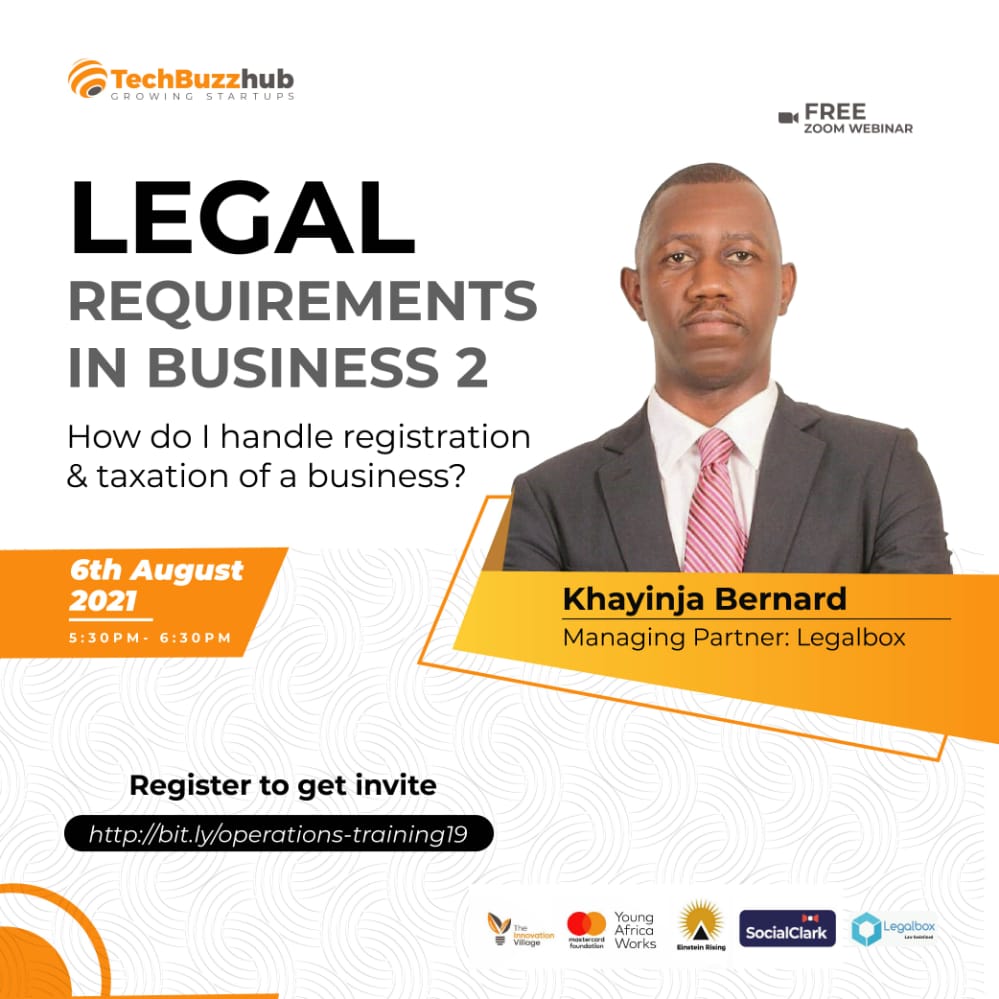
  • LEGAL REQUIREMENTS OF A BUSINESS – TRAINING-2

    LEGAL REQUIREMENTS OF A BUSINESS – TRAINING-2

    How can I handle registration and taxation of my business?

    Yes, we understand that the topic is very crucial in the well-being of your business and still we want you to have a better understanding of these concepts and ideas. That is why we again bring you the legal requirements two session where we had Mr. Bernard, a lawyer and consultant in the startup ecosystem, working with the Legal Box, as managing Partner to help us understand in the best way possible how to juggle the law and still make profits even in your initial stages of your business, in a more convenient way that will not reflect back in the future negatively to your business.  This article is entirely based on the interaction we had with him on the topic aforementioned. Among the many questions he was faced with, is, what is a business? how do you successfully run a business in this era? You can always find the live recording of the meeting at the link provided……….

    What is a business? According to Bernard many people confuse a business and accompany in terms of which, if the two comes first. Do I have to first have a company or a business prior to the other respectively? He says you must first be in business before you actually have a company or else you may end up never having a company.  A business for that matter, is a venture where goods and services are produced, it has a continuous system or process of production with a profit motive. 

     What are the types of businesses provided for under the law? The law in itself is so broad and explains in depth what entails business transactions, contracts and agreements and what transactions are legally binding, what documents are credible for one to start running a business. So as a business owner one must always try to understand and interpret the law in order not to fall on the disadvantaged side of the law. Various types of business have various modes of operation which the law looks at differently. 

    The types of business include; the sole proprietorship, partnerships, limited companies, social; enterprises and Sacco’s, I shall try to explain a few details about each of these for your better understanding.

    SOLE PROPRIETORSHIP; is a kind of business where the owner of the business has full control and power over the operations and management of the business. Because he is the everything of the business it’s cheap and easily managed. The business enjoys a freedom from the tax collector to choose how much taxes he pays depending on how much you earn and how well you file your returns. At registration, the business owner is asked to register the business name, his own name as well, this gives the company/ business ability to operate in its own name. The disadvantage with sole proprietorship is that the business does not get to own property, neither can you hold property

    PARTNERSHIPS. Unlike sole proprietorship, in partnerships two or more people come together to establish and run business. Many partnerships happen because of money, skill, collaboration among others. It is cheap and easy to maintain. Partnerships can be to as many as 50 people in a single partnership. But anyway, they are not in position to hold and own property. Usually what they do is to hire or get a trustee in order to own property.

    A limited and unlimited partner; a limited partner is one who is limited in his liability to the company. In terms of losses and profits and decision making. An unlimited partner is one who is unlimited even when it comes to loss or profit margin sharing. This means that; whereas a limited partner is not exposed to personal property being liable to recover business losses, an unlimited partner is exposed to having all his belongings including costs liable to be used in the recovery of company losses. This is because he is fully in management of the business.

    LIMITED LIABILITY COMPANY. It’s one of the best investment vehicles. It allows one to 100 people to be members of the company. The assets of members of the company are separate from the company assets. This means that the company faces and enjoys its profits and losses. The company is a legal person in the sense that the law recognizes them as persons that are in position of suing or being sued in their own name. it has a fairly expensive registration procedure and it involves many compliance procedures, thus making it expensive to maintain. It can be dissolved any time the management feels its running out of business. This is easily through filing bankruptcy.

    SOCIAL ENTERPRISES.  Sometimes called a limited liability company or company limited by guarantee.” Example of such companies is the Jibu Water company. Many are created to help lower income earning people to sustain their lives and also help the community. They can include up to 100 people as members. It involves a fairly complex registration process. Which as well involves registration to become an NGO. The URSB process costs about 180000/=, with forms of about 5000/=, to 6000/= each.

    The only challenge with social enterprises is that they fall in the middle and the social and the business community do not trust them to make profits. They may easily fall out when it comes to funding to scale.

    SACCOs, Savings and Credit Cooperatives Societies. These are very common today and operate under the models as shall be explained to you below;

    1. Pull investment i.e. you get money and add it up in the same basket from which you are apportioned something equivalent to your input investment.
    2. Revolving funds i.e. people put money together and one by one a particular person is given that money for and after a month and it keeps revolving so much that each month there is someone who gets one whole some and it keeps revolving.

    They are very quick tools for financing drives. They however are very risky as they involve people of all nature. There are high levels of fraud evidenced in day to day life.

    After talking about all the various types and kinds of businesses and companies and their modes of operation. We want to now deal in successful operations. What do you need to know when it comes with operations?

    Know your gatekeepers.

    A gatekeeper is a person who authorizes your business operations, one who authorizes any action that your company or business is to partake in. Examples include, Uganda revenue authority (URA), Uganda registration service bureau (URSB), Uganda investment authority (UIA), national drug authority (NDA) among others. 

    The advantages of these are that if you know your gatekeepers and you are compliant to the way they regulate business operations then you are bound to having a successful business.

    The question then is how do I conduct proper business?

    In business it’s important to know that the best weapon in business operations is the use of paper work. Mr. Bernard holds it that companies do not shake hands every single transaction of a company should be documented because in the eyes of the law, or from a legal perspective documents are key evidence of transactions therefore you must know what constitutes a business document.

    What constitutes a business document? This question can take you about another full lesson however to briefly list them out and talk about what is necessary. We have a list of business documents like the receipts, invoices, letter of intent, memorandum of understanding, contracts, resolutions. Avoid any business operations without an existing paper work to prove the existence of that understanding. Without documents, you forfeit your rights to enforce your economic rights.

    Conclusion 

    The question asked is what next? After looking at all the aforementioned issues, your business structure tells you the best way you are to carry out your operations. So depending on the manner of business structures, different legal compliance and government rules will apply to you.

    You need to strongly understand the type of business in which you belong, the authority that is right at your door and then oversight of the restrictive rules imposed on your company. This is because you do not want the government to get in your way, for it then shall be hard for you to do business.

    My advice is that you consider structures that operate in a more friendly regulatory environment.

    Finally, I want to make this clear. That risk is quantifiable; uncertainty you don’t know! Risk cannot make you a billionaire but uncertainty can make you a billionaire. Always remember entrepreneurship is about having the right people, process and standards perspective around you. This is guaranteed at TECHBUZZ HUB 

  • MANAGING YOUR RESOURCES FOR INVESTMENT- TRAINING

    MANAGING YOUR RESOURCES FOR INVESTMENT- TRAINING

    How do I save and invest in business? BY DANSTAR FROM Y-SAVE.

    Among the many things the pandemic has brought forth, are questions surrounding the need for financial sustainability. The questions of how can we comfortably navigate the numerous unending lockdowns that have been put up by the pandemic. Today we are here to answer your questions, we brought you Danstar from the Y-save foundation and organization that is a business and financial consultancy and they have for a while been advising businesses and individuals on the right ways of saving to investing.

    What resources are we talking about? 

    There is a common claim of absence of capital to start investment. In this case the resource we shall dwell in are two the individual, and the money or capital.

    • An individual is the first resource. Your head, yourself are the first individual. The ideas begin with you, and your brain. However, there are scenarios where one person links up with a group of other individuals to come up with better ideas and information for the different things they are partaking. The first resource is an individual. Who bears the idea, and enriches his learning and understanding through research, and sharing with reliable sources, like human resources to give you the experience of those they have acquired over time. The individual and human resource are the first things to consider. However always consider the element of trust. 
    • Money. Do you save. Make it a habit that every time you get money you get off some percentage to have it saved. Where do you save, there are very many instruments and tools for saving? Banks unit trusts and investment clubs among others. Today I would advise people to get more into the unit trusts this is because they provide and calculate savings daily.

    What other channels are there for you to raise resources for your business?

    • Your family and friends.
    • Donations and grants from people who are not necessarily your friends or family, but are ready to donate to your idea.
    • Proposals and research. 
    • Partners. By partnering with other people they help inject money into your business/ idea so as to gain and you get your business growing.
    • Selling of your assets. Like land a car, among others

    Another channel is through donations and grants. Many people can get through their businesses by borrowing money form money lenders. However, it’s not advisable to start a business on a loan. In other cases, you may have to partner with other people in order to get the business. There must be a very big element of trust in a partnership. Do not partner with people you don’t trust.  

    Your family members and friends can as well be a good source of money. They can give you money that you are not going to refund back. They are a good source of startup resource. Whenever you get the resources start small and begin growing your business whenever you grow. Minimize costs especially fixed costs.

    Others consider proposals and request for grants to start their businesses. These are the ways in which you can also get resources from the people who are not necessarily your family members but they can provide you with the money through looking at your proposal.

    How do you get a profit oriented entrepreneur to start investment?

    You start a business to meet a need, when you meet a need then the profits will come., secondly do not put all your eggs in one basket. In other words, have many places or areas where you can gain profit from. Have more than one place where you know you are gaining and reinvest in something else. 

    The money that you gain from your business should be in position to help you grow and invest in another business besides the one you are prospering in. through your research and human resource, think of other areas where you can profitably reinvest.

    Which funds are you telling the entrepreneurs to re-invest from? 

    Using my personal example, my wife imports and sells clothes, assuming she used 2 million to import that is capital. After selling them you have 5million, made a profit of 3million. There are two options.

    • You can either use your profits to reinvest in your business. For example, increase your capital from 2million to 2.5million. and then use the rest to save and facilitate your expenditure.
    • Or You can as well decide to still save your profits and reinvest the same initial capital for your business, and when your business continues accumulating profit then you can start another business out of your savings from your profits.

    As a concrete rule for saving “It’s very important to have or save 20% of your business profits” sometimes others say at least 30% of your profits. You can only achieve this by daily track of your inventory or stock from your business. 

    At what point does a business owner know that they have arrived the time to start another venture or another business? 

    Assuming everything is constant, meaning you have been saving amidst your profits and returns. You need to make research. It goes back to the human resource, you need to make research on how much you need to start another venture, you need to know what it takes to satisfy a need, in the community. So after analyzing these facts and critically focusing more onto what and how you can reinvest.  Then you set out your boat to start reinvesting and start up a given venture basing on your research.  It’s just unfortunate that these are hard times and research made during this time, you may not make conclusive research.

    Where are we investing our money after saving and when an individual is investing is it the same as a business investing?

    • Businesses and money and finances are based on principles.
    • As a golden principle, you should invest in something that you understand. Never invest in something that you don’t understand.  Then you should also invest in something that you are passionate about. Something that you love doing.   You want to invest what do you have to look at it.
    • You must be saving consistently.
    • Look for the investments. How something that you love, something that you are passionate about. In other words, something that will work for you may not work for your friend. 
    • Seek for advise on things that you love to do and you are passionate above.
    • Never invest in unfamiliar businesses. Don’t move with the band wagon you may end up where you don’t want to.
    • Avoid those investments that bring you extraordinary profits. It’s a pointer to what the level of risk it is. High risks high returns and high losses. Be prepared for all these.

    How do you decide what to invest in.? 

    • What are you passionate about, what do you know about that venture? Then you move into the matrixes. Your investment portfolio.  You have to keep monitoring your loans, your expenditure, and your must have the discipline to realize that every other part of your finances should not exceed that limit you set for yourself. There are set limits like, loans should not exceed 70% of your total income etc.

    What can we entrepreneurs do when such times as the COVID 19 pandemic came through?

    The best way to protect our businesses in such hard times, is for it to have a backup plan. That goes back to saving. It’s the only way of being resilient in your business. 

    In conclusion.

    •  Never resign from your job until you know and you are sure of where you are going. Its rather better to think of your job as going away tomorrow and that means the saving culture kicks in. keep saving and preparing yourself for the time where you have actually lost the job. 
    • We save money because we need to survive in future, just start now and you will not regret